Orthodox Zlatibor
Orthodox churches in Zlatibor
Orthodox churches and monasteries on Zlatibor
Welcome to Orthodox Zlatibor!
Return with a soul full, or remain calm.
Christ is risen!
Presentation of churches, monasteries and chapels on Zlatibor of the Serbian Orthodox Church
Church of the Transfiguration of the Lord on Zlatibor
Church of the Transfiguration of the Lord on Zlatibor
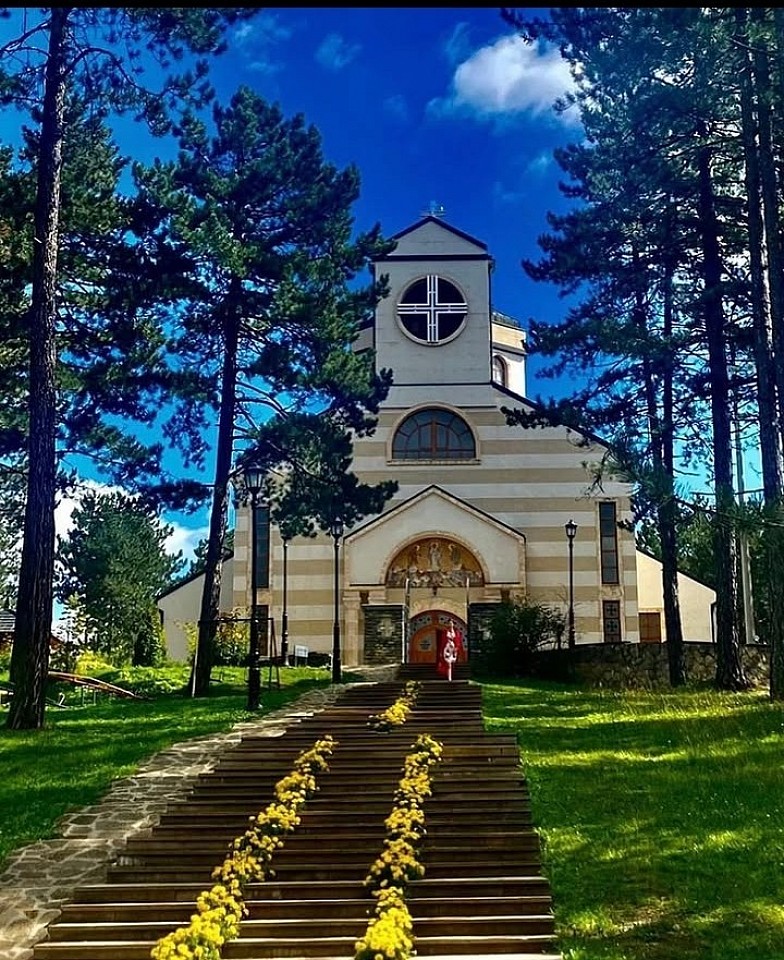
The Church of the Holy Transfiguration of the Lord is located in the very heart of the tourist center of Zlatibor. At the request of the locals who inhabited the center of Zlatibor, but also due to the needs of the increasing number of tourists, in a place that was previously uninhabited and therefore did not have a church, the construction of the church began in 1993. The construction of the church lasted a full twenty years and was consecrated on St. Michael's Day in 2013. It was built with contributions from believers, donors and funds from the local government.
At the initiative of the locals and the then Čajetin parish priest, now Šljivovići parish priest, Dragiša Đuričić, the construction of the church began in 1993, and the blessing for the beginning of construction was given byBishop Stefan of Žička . The construction of the church, with contributions from believers, donors and funds from the local administration, lasted a full twenty years.
The temple stands out for its beauty and monumentality. In terms of its architectural concept, this church represents a complex combination of different styles. The central spatial organization of the domed temple with a three-part altar space on the eastern side and a spacious narthex surmounted by a bell tower was taken from the endowments of the rulers of the holy Nemanjić dynasty. The Church of the Transfiguration on Zlatibor is a three-nave building with a transverse nave, which forms an elongated cross with a central nave, an altar apse on the east, a narthex with an entrance, a spacious gallery and a bell tower on the west. Next to the main temple on the northern side is a chapel dedicated to the Holy Prophet Moses , while the baptistery is located in the southern part. The Church of the Holy Transfiguration of the Lord on Zlatibor, in appearance, leans on the tradition of the "Raška School". It was built as a single-nave vaulted building, covered with sheet metal, with a dome in the middle. The dome is placed on a cube-shaped base. On the west side there is a narthex with a bell tower, and on the sides there are choir transepts. On the east side there is an apse, semicircular on the inside and triangular on the outside, to which a proskomidia and a diaconicon are added on the south and north sides. The church occupies an area of 520 square meters.
One of the rarities of the temple is the cross, which is raised at the highest point of the church. Its uniqueness lies in the fact that the four letters "S", which are located on it, are turned towards each other. In it, the famous motto of the Serbian people "Only unity saves the Serbs" finds its full expression.
In the church gate there is a church shop where you can find a large selection of icons, a rich spiritual literature, as well as everything necessary for a Christian family. The entire complex is rounded off by a beautiful parish house, a guest house and rest rooms. The parish house was designed by architect Branko Ignjatović.
The service is currently being conducted by Archpriest Dejan Vojisavljević , who is also the head of the church, Archpriest Miodrag Todorović , and Deacon Nenad Srećković .
The church in Zlatibor is a parish church and is located in a residential area in the center of Zlatibor on the territory of the municipality of Čajetina at the address: Ćaldov put bb, 31315. ( map ). The Church of the Holy Transfiguration of the Lord in Zlatibor is open every day from 07:30 - 18:30. ( clergy of the church )
The Church of the Archangel Gabriel in Čajetina on Zlatibor
Temple of Archangel Gabriel Chajetin
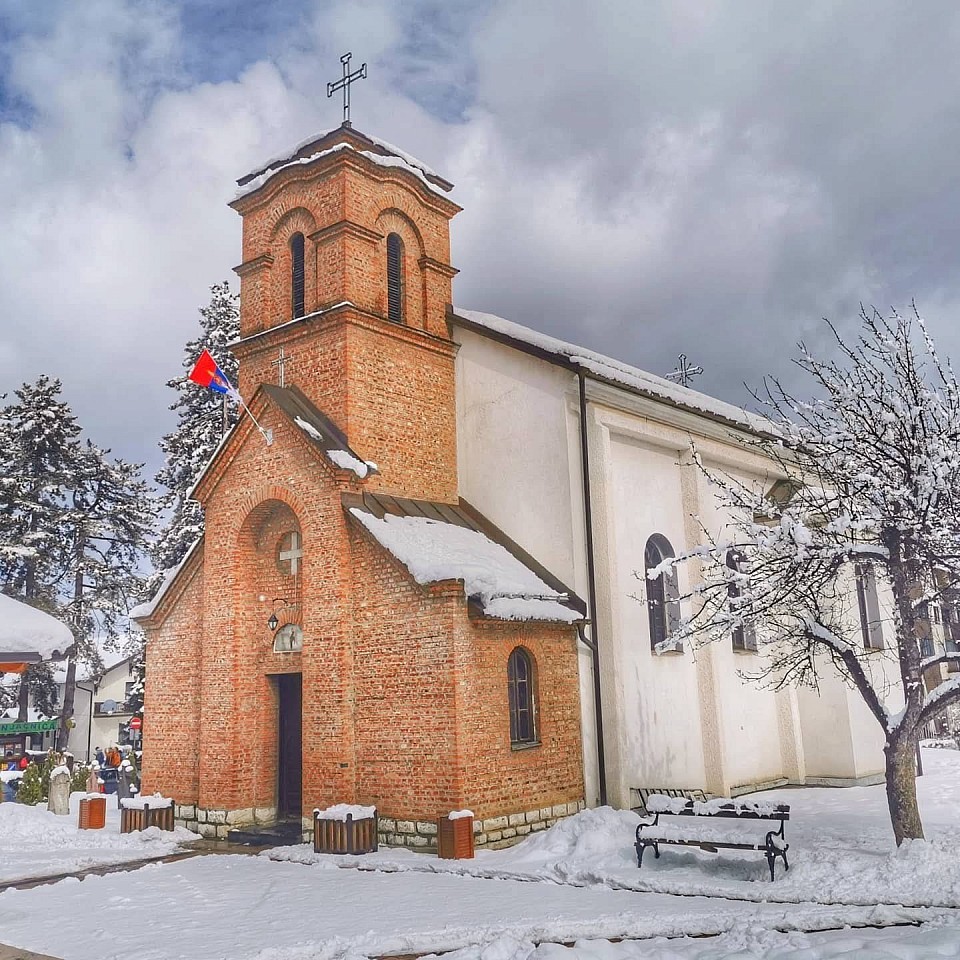
The Church of the Holy Archangel Gabriel in Čajetina was built at the end of the 19th century and is one of the most important Orthodox churches on Zlatibor. It is located in the very center of the town of Čajetina and belongs to the Diocese of Žička of the Serbian Orthodox Church .
History of the temple
The construction of the church began in 1886 and was completed in 1890. The first priest, Milivoje Obradović, was appointed the same year, thus beginning organized spiritual life in Čajetina. One of the most significant moments in the history of the church was the visit of King Aleksandar Obrenović in 1893, who left a handwritten note in the church service book.
In 1962, a narthex with a bell tower was added. A major restoration of the church was carried out between 2016 and 2021. At that time, the roof was replaced, a new iconostasis was installed, the walls were painted, the gate was restored and a chapel was built, the priest's apartments were renovated, and a parish house was built.
Architecture and artistic value
The Church of the Holy Archangel Gabriel is a building in the spirit of traditional Serbian church architecture. It is a single-nave building with a semicircular apse and a barrel vault. Inside, there is a new wood-carved iconostasis, installed in 2020, as well as valuable frescoes created in 2021, the work of academic painter Goran Pešić. The church preserves a rich treasury of old icons and liturgical books. Among them, the Gospel from Moscow from 1814 and the Service from 1838, a gift from King Aleksandar Obrenović, stand out.
Today, the church is governed by Archpriest Petar Lazić and Archpriest Milan Mijailović .
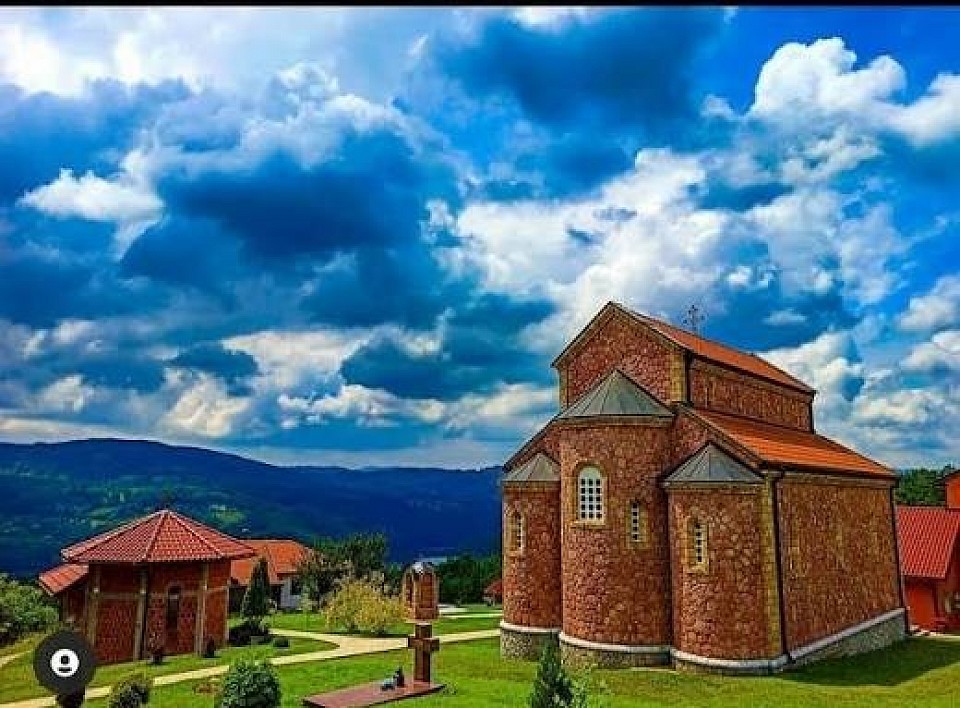
Rujan Monastery Zlatibor
Rujan Monastery
The Rujan Monastery is located in the village of Vrutci, in the immediate vicinity of the lake of the same name, and belongs to the Diocese of Žička of the Serbian Orthodox Church . The monastery church is dedicated to the Holy Great Martyr George . It is some twenty kilometers away from the tourist center of Zlatibor, and the shortest route to it leads through the village of Tripkova .
The Rujan Monastery was built between 2004 and 2006, and was consecrated on May 5, 2007, when monastic life began there. Architecturally, the church of the Holy Great Martyr George belongs to the basilica form, making it unique in the Diocese of Žička .
It is a restored 15th-century monastery that existed not far from the current one, but was destroyed during Turkish rule. The remains of the original monastery were finally submerged by the construction of the Vrutci reservoir.
The Rujan Monastery played an important historical role and was a significant spiritual and educational center around which the Serbian population gathered during the Ottoman era. In the first half of the 16th century, one of the first printing houses in Serbia operated there. It was where one of the most important monuments of Serbian medieval literacy was created: the Rujan Four Gospels, the first printed book on the territory of Serbia. The book was printed by the monk Teodosije, most likely in 1537. The only completely preserved copy is today kept in Prague, in the Šafarík Library.
In the monastery gate there is a monument to the monk Theodosius, and, according to his own wish, the Bishop of Žica, Hrizostom Stolić (1939-2012), who initiated the renovation of the monastery, is buried there.
The monastery is male. It is always open, as is the room where candles are lit. The liturgy on Sundays and holidays begins at 8:00 a.m.
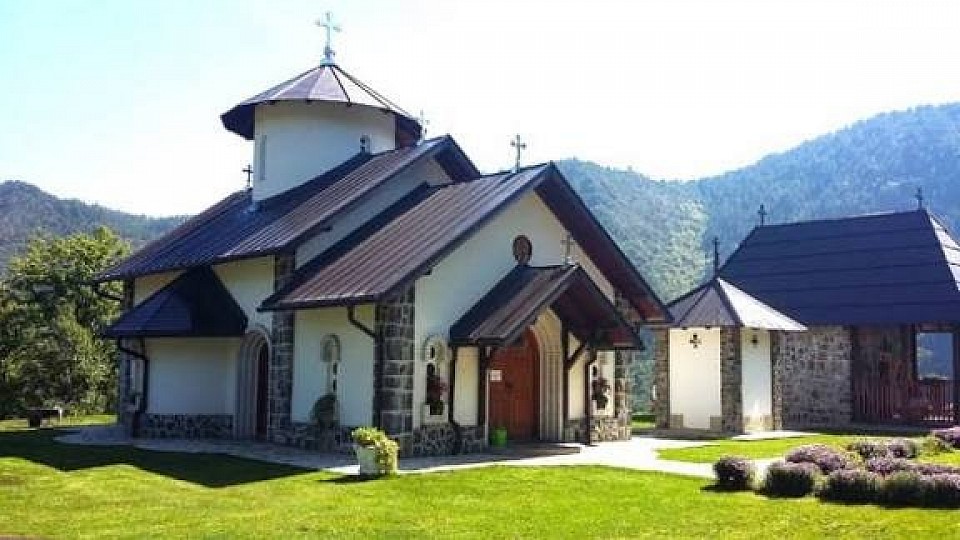
Dubrava Monastery Zlatibor
Dubrava Monastery
Dubrava Monastery is located in the Zlatibor village of Stublo and belongs to the Diocese of Žička of the Serbian Orthodox Church .
There is no reliable written information about when the monastery was built. Assumptions based on written sources indicate that the Dubrava Monastery was a metokh of the Pribojska Banja Monastery, based on which it is believed that it was built during the 13th century.
The monastery was supposedly destroyed in the 17th century. The ruins of the Dubrava monastery are mentioned in some writings in 1853, and it is assumed that the Turks looted and burned it to the ground at the same time as the Pribojska Banja and Uvac monasteries.
The restoration of the monastery was initiated after three hundred years by the abbot of the Dubrava Monastery, monk Danilo, formerly a monk of Chilandar. During archaeological excavations in 2004, the remains of the monastery church, the refectory, fragments of medieval ceramics and 260 Venetian ducats were discovered.
A new church dedicated to Saint Panteleimon was built on the foundations of the old church of Saint Elias . It is a small, single-nave building with a semicircular altar apse on the east side and a small wooden entrance porch on the west side. It is covered with a shingle roof. It is built of cut stone and plaster, which reminds us of the church of the Uvac monastery. Next to the small church, a new church dedicated to Saint Basil of Ostrog was built. It is a single-nave building with a semicircular altar apse on the east and side chapels on the north and south sides. A narthex was later added to the church on the west side. The church is covered with a gabled tin roof and surmounted by a semicircular dome.
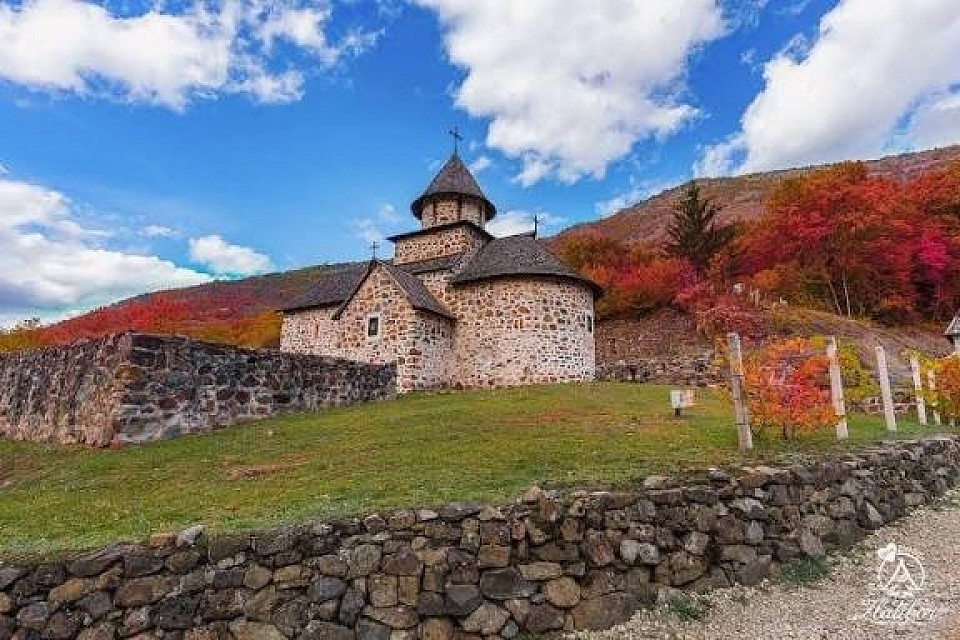
Uvac Monastery Zlatibor
Uvac Monastery
The Uvac Monastery is located at the bottom of the Uvac River canyon at an altitude of about 520 meters above sea level. It is located in the village of Stublo , on the border of the municipalities of Čajetina and Priboj . In 1994, the walls of the church were discovered and excavated at a large archaeological site. The entire Uvac monastery complex is a testament to the existence of a large spiritual center in this area.
There is no exact information about who built the monastery, who renovated it, or when and how many times it was destroyed. On the pages of a church book from 1622, it was learned that the temple was dedicated to the Nativity of the Blessed Virgin Mary . Therefore, thanks to research and the work of the National Museum in Užice , the Uvac Monastery was restored and placed under state protection.
Uvac is one of the most difficult to access medieval monasteries in our country. During the time of Patriarch Paisius, it was certainly a monumental monastery complex, with all the auxiliary rooms, buildings and an exemplary economy. It is known that during the time of its greatest rise in the first half of the 17th century, the monastery was visited by many travelers and high-ranking church administrators. The monastery was destroyed and rebuilt several times, but it is not recorded when it experienced the last cataclysm, because after that it has not been rebuilt to this day.
However, this mighty temple in the Uvac valley was not easy to destroy, although the Turks tried several times, but it was unsuccessful. Usually one of the destroyers always died. The Turks were then told that only Serbs could destroy the monastery. Then they found Serbian settlers who, according to tradition, easily destroyed Uvac.
The demolition of the monastery and the disappearance of life from the tame valley of the Uvac River is probably the reason why we are deprived of important historical data from the past of this spiritual center.
One important figure of the Serbian Church spent some time in this monastery under Crni Vrho. It was Saint Joseph the New Metropolitan of Timisoara , who is believed to have been responsible for hiding the treasury of the Banja Monastery near Priboj in the Diocese of Milesevo , probably before the expected Turkish invasion.
Traditions, most often passed down orally from generation to generation, have linked the Uvac Monastery to the Nemanjić foundation . The story goes that Janja, the sister of the great župan Stefan Nemanja, was supposedly built a monastery by her brothers in a remote area where she would become a monk and spend the rest of her life.
Today, the monastery is no longer so difficult to reach. After the center of Zlatibor towards Priboj, turn right from the main road, where the signs lead past Ribničko jezero , to the village of Sublo . After the center of the village, the road continues towards the Dubrava monastery , and for Uvac, a macadam road branches off to the right, which is well marked to the monastery itself. It is about 25 kilometers from the center of Zlatibor to the monastery.
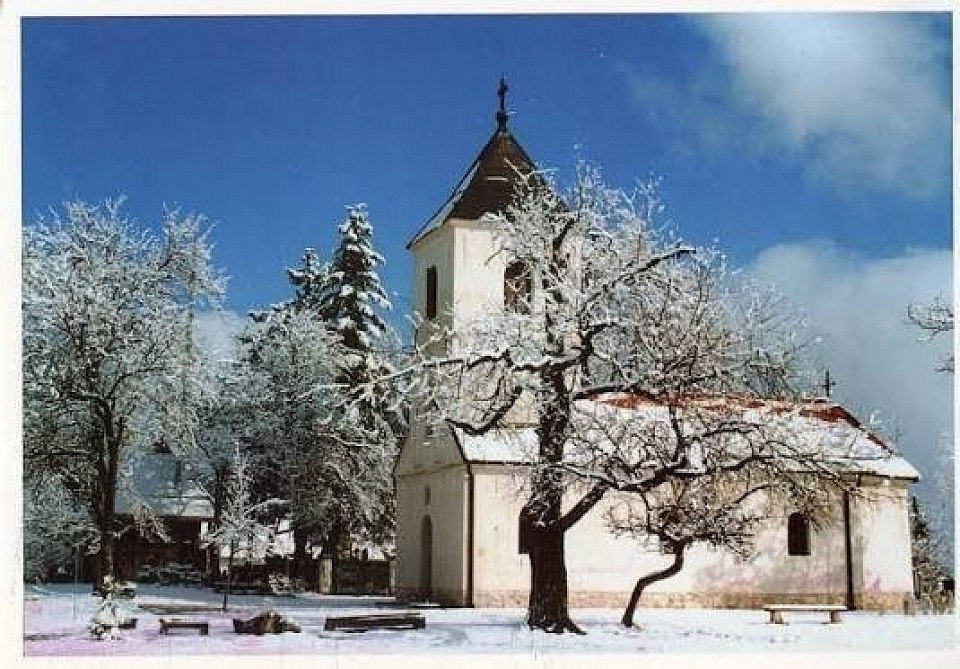
Church of the Holy Apostles Peter and Paul in Sirogojno
Church of the Holy Apostles Peter and Paul
in Sirogojno
The Church of the Holy Apostles Peter and Paul is located in Sirogojno , and belongs to the Diocese of Žička of the Serbian Orthodox Church .
Construction of the church
The church was built in 1764 on the initiative of Archpriest Georgije Cmiljanić from Ljubiš . It was originally built of stone as a small church for the needs of the village. In the same year, the iconostasis was painted by the then young icon painter Simeon Lazović from Bijelo Polje . It was later discovered that this was also his first work on the altar. The text that stands on the wing of the imperial gate and testifies to the authorship of the most important icon painter of that time reads: "The shining door was painted by the sinful icon painter Simeon Lazović from the place of Bijelo Polje, God forgive me in 1764."
The church is whitewashed, without painted walls, and covered with a characteristic Zlatibor wooden roof. There was also a village cemetery in the gate, as evidenced by numerous stone monuments. At the end of the 19th century, a bell tower was built instead of the wooden porch at the entrance. Above the entrance are two niches with frescoes of the holy apostles Peter and Paul .
In his work "Travels through Serbia" , printed in 1828, Joakim Vujić mentions his stay in Sirogojno and the existence of the church: "In this village there is a new church of peace with a beautiful vestibule. The church is of a decent size, and was built by the people with the founders and contributors. At the entrance to the church from the west side, in the vestibule, above the door, you can see the image of St. Peter and Paul with a single lamp..."
Church renovation
At the end of the 19th century, the already quite damaged church underwent its first major renovation, during which it lost a good part of its original appearance. Some of the valuable icons were moved to the National Museum in Užice , while others were given to private individuals for safekeeping. In 1922, panels were placed on the walls, the work of the painter and sculptor Mihailo Milovanović , with the names of soldiers and parishioners who died during the wars between 1912 and 1918.
The Second World War and the period after it led to the neglect and decay of the church, and its restoration began in the 1990s. The roof was replaced, it was plastered, and part of the original iconostasis and some of the original icons were restored.
The Church of the Holy Apostles Peter and Paul, together with the Open-Air Museum "Staro Selo", represents a unique entity that was declared a cultural asset of exceptional importance in 1983.
The head of the temple today is priest Marko Denić, tel. +381642222658
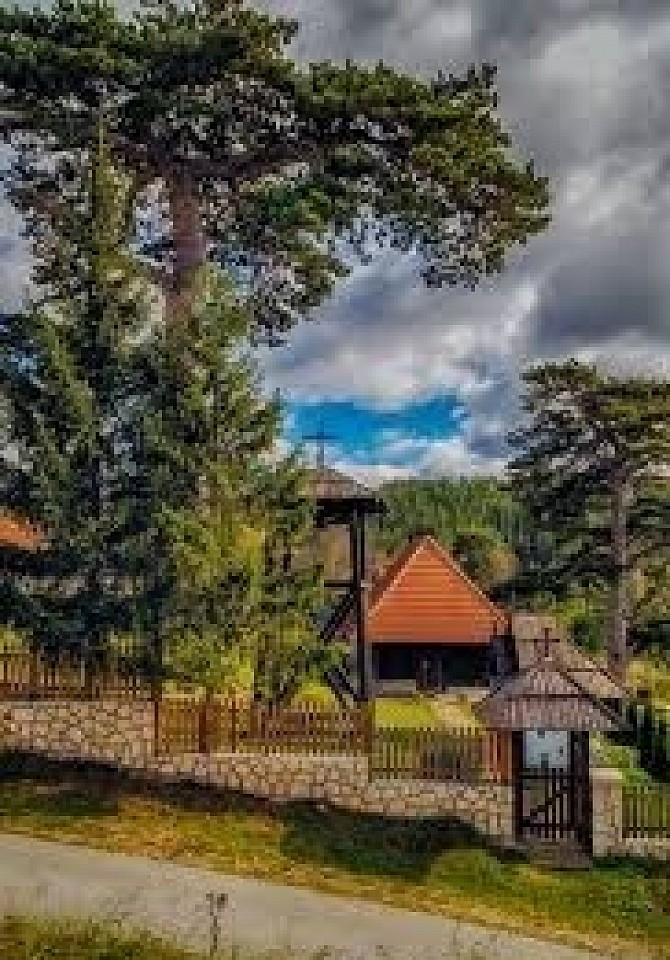
The log church in Dobroselica Zlatibor
Church of Saint Elijah
The log church in Dobroselica
The Church of St. Elijah in Dobroselica is one of the most beautiful and oldest log churches in Serbia. It is located 20 kilometers from the tourist center of Zlatibor and belongs to the Diocese of Žička of the Serbian Orthodox Church .
The temple was built by the builder Mitar Udovičić from the village of Stubla . According to legend, there was an even older church on the same site – the endowment of an unknown hajduk. According to legend, the Turks tried to set fire to that first church in 1809, but rain extinguished the flames and the temple survived. The current church was built in 1821. People still say that the entire log cabin was built in one night, in order to avoid Turkish interference in the renovation.
The church is built entirely of wood – planks joined with wooden wedges, without a single nail. It is basically rectangular, with a semicircular apse and a wooden bell tower on pillars. The original roof was covered with shingles, which was replaced with tiles in 1938. In 2021, the traditional roof of beam shingles was restored, on the occasion of the great jubilee – 200 years of the church’s existence. The interior of the church is decorated with a wooden iconostasis painted in blue, with icons by significant Serbian painters of the 19th century – Janko Mihailović Moler and Aleksije Lazović . The imperial doors, painted with scenes of Christ and the Virgin Mary, are particularly noteworthy.
The Church of St. Elijah in Dobroselica is under state protection as a cultural monument of great importance. Thanks to the locals and experts from the Institute for the Protection of Cultural Monuments , the temple has been preserved in its original form and is one of the most beautiful examples of log churches in Serbia. There are also three old pine trees in the church's courtyard. They are over 20 meters high, and their age is estimated at more than 300 years. These natural giants are under protection as natural monuments of exceptional importance.
Visiting church
The church is active and services are occasionally held there, especially on holidays. The most important event is the village celebration – Ilindan (August 2), when the holy liturgy and a folk assembly are held. Also, on Christmas Eve, a traditional Christmas tree is lit in the churchyard.
Although it does not have fixed opening hours, the temple is open during major holidays, and with prior notice to the priest it is possible to enter the interior. Visitors who love spiritual peace, tradition and authentic folk architecture will experience a special impression here.
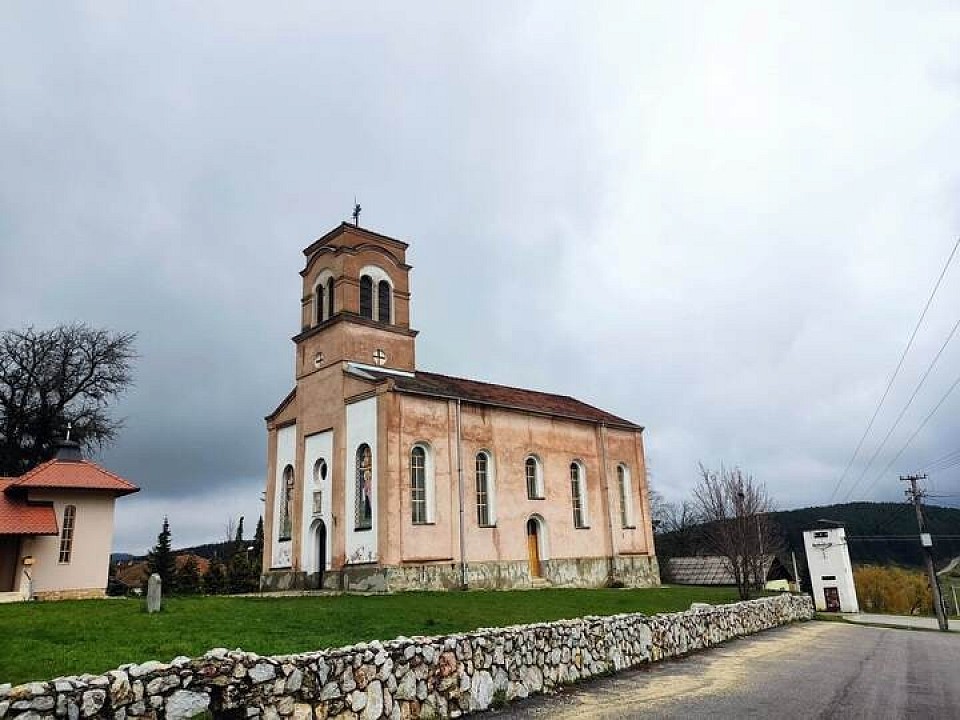
Church of the Holy Prophet Elijah in Machkat
Church of the Holy Prophet Elijah
in Mackat
The Church of the Holy Prophet Elijah is located in Mačkat and belongs to the Diocese of Žička of the Serbian Orthodox Church . It is 10 kilometers from the tourist center of Zlatibor , approximately halfway to Užice.
The church was built in 1859. It was painted during that period, but the original fresco was largely destroyed and later covered with plaster. Initially, the church bell stood on a single pear, and the bell tower was later added.
The Church of the Holy Prophet Elijah in Mačkat is a single-nave church with a semicircular apse. The iconostasis in it dates from the 19th century, made of wood and partly of canvas. Of the valuables from that period, a shroud and a cross made by a blacksmith are kept in it. In the church's gate are the refectory and the bell tower. On the west side, to the left and right of the door, there are two frescoes made on fresh plaster, the work of Danica Jevtić Šišović . The frescoes depict Saint Elijah and the Virgin Mary with Jesus.
During its existence, it was damaged several times, and in 1995 it was completely renovated. At the beginning of the 20th century, the first damage appeared, most likely due to subsidence. In 1917, the Austro-Hungarian army mined the bell tower, damaging the walls of the church. It was renovated in 1935, thanks to the efforts of Bishop Nikolaj Velimirović , and residents of the surrounding villages participated in the renovation.
It also suffered extensive damage during World War II. The decline continued over the next three decades. In 1974, Radojica Vasiljević came to it as a parish priest. In 1977, he began raising funds and managed to partially replace the roof structure, thus protecting the church from further ruin. In 1995, the roof was completely replaced, and the church was covered on the outside with painted plaster that protects the walls from weather damage.
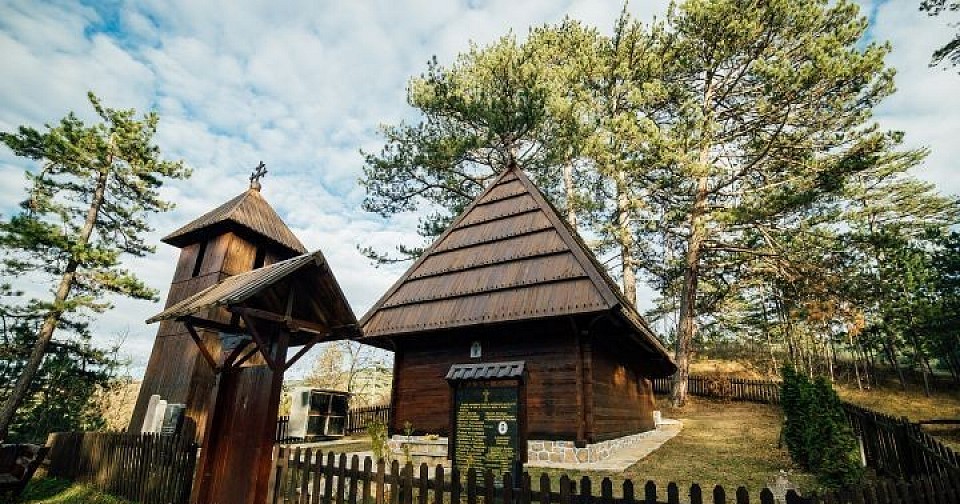
Log cabin church in Jablanica Zlatibor
The log church in Jablanica
The log church in Jablanica is located about 25 kilometers from the center of Zlatibor . It was built in 1838 and is dedicated to the Protection of the Most Holy Theotokos .
It is built of logs in a rectangular base, with a semicircular altar apse. The church has two doors, on the west and north sides, and very small windows. The width of the church is about 5.5 meters, and the length is about 9.5 meters, and it belongs to small wooden churches. The roof is extremely steep and covered with shingles. The construction method, woodwork and decorations are similar to the Dobroselica Church , so it is believed that the same builders built them.
The interior is divided by an iconostasis into the altar section and the nave. The Imperial Doors by the painter Sreten Protić Molerović have been preserved from the old iconostasis, commissioned by the local population, who contributed to the construction of the church. The throne icons of Jesus Christ, the Most Holy Theotokos with Jesus Christ, and the icon of Saint Basil of Ostrog with Saint John the Baptist were painted in 1851 by Dimitrije Posniković. In 1958, Jaroslav Krtija created 23 icons depicting holidays and, with the help of priests and locals, placed them in two rows above the throne icons on the iconostasis.
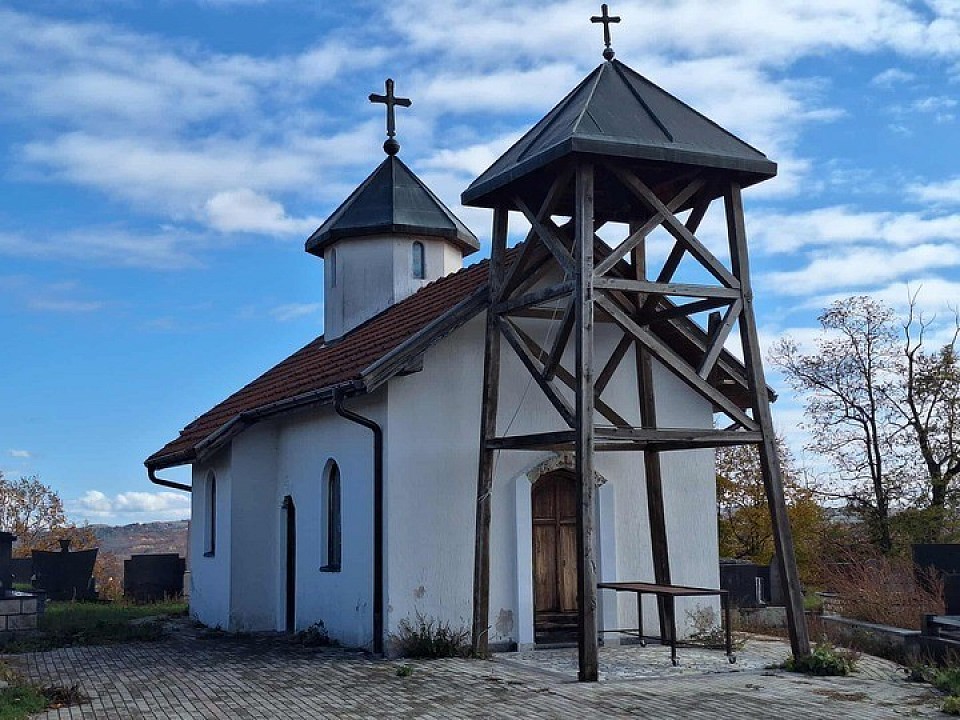
Church in Tripkova Zlatibor
Church in Tripkova
The Church of the Holy Great Martyr Nedelja is located in the center of Tripkova , a part of the village called Žigale and belongs to the Diocese of Žiga of the Serbian Orthodox Church .
The church was built on the foundations of a cemetery chapel that was built in 1861 and belonged to the Mačkat Parish. This chapel was a place of spiritual gathering for the inhabitants of Tripkova , and village fairs were also held next to it. The chapel collapsed in the mid-twentieth century. The then parish priest of the Mačkat church, Sredoje Čutović, managed to preserve the imperial doors, which were kept in the Mačkat Church until 2000.
In 1999, Colonel Desimir Savić launched an initiative to restore the church. With the support of the locals of Tripkova and the then parish priest Radojica Vasiljević , construction work began. The church was completed in 2003, when it was consecrated.
The Church of the Holy Great Martyr Nedelja was built for the most part with contributions from locals with some help from the Municipality of Čajetina . The preserved imperial doors, the work of Aleksije Lazarević , were restored and returned to the church. In addition to them, the icons of the Virgin Mary and Jesus Christ, the work of the same author, were returned to the church. The complete fresco is the work of Danica Jevtić Šišović . From the ruins of the original chapel, lintels were also removed and installed above the central and northern doors of today's church.
A dining room was built in the church's gate as a gift from Dragan and Milica Irkić and their sons Ilija and Petar.
In 2011, a stone candlestick was built, a gift from Radojko Tošanić.
The Church of the Holy Great Martyr Nedelja today belongs to the Church Municipality of Čajetina .
Church in Semegnjevo Zlatibor
Church of the Nativity of Saint John the Baptist
in Semegnevo
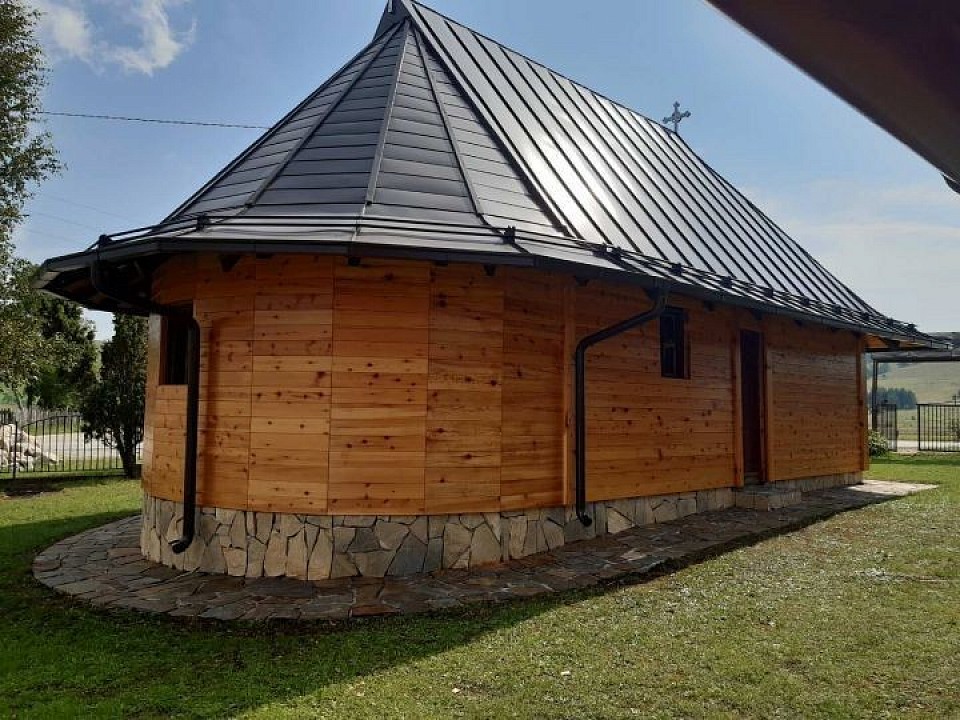
In the picturesque village of Semegnjevo in Zlatibor, at an altitude of 1200 meters, rises an architectural and spiritual pearl, the Church of the Nativity of St. John the Baptist . It was built back in 1927 and testifies to the struggle for life and love of the people of this area. The land and money for the construction of the church were donated by a local woman, Savka Đurić. This is evidenced by the foundation plaque, which reads: "This holy temple, dedicated to the birth of Saint John the Baptist , was erected in eternal memory of her parents, father Jevrem, mother Stanislava Kostić, husband Ljubomir, children Miodrag, Slavko and niece Vinka. Savka Đurić from Semegnjevo . The site for the church was donated, and the same was built, in Savka's name, by Branko Piščević with his sons, during the service of the parish of Dobroselička by hieromonk Marko Popović from Slatina. Danilovgrad 1927."
The Church of the Nativity of Saint John the Baptist is a single-nave, log-framed church of smaller dimensions, built in the spirit of 18th and 19th century architecture. It is built of hewn logs with a rectangular base that ends with a semicircular wooden apse. The church is lit by three windows, the southern, northern and eastern, which illuminate the apse. The roof is made of wood, covered with tin, and next to the church there is a bell tower, supported by four concrete pillars.
It is completely decorated with icons, which were donated to the church by the residents of Semegnjevo . Today, the number of icons on display reaches one hundred and fifty. There is no information about what the church originally looked like, but it can be said with certainty that the descendants of Savka Đurić continued to take care of the church and further decorate it.
The church underwent a major renovation in 1998, when a hall for public gatherings was built in the gate. Between 2004 and 2012, the church was decorated with new icons on the iconostasis, the work of our local icon painter, Mrs. Danica Šišović . With the help of the local government, the roof was re-roofed. The church was sheathed with new logs.
In addition to its spiritual value, the wooden temple in Semegnjevo represents a more touristic value of the Zlatibor region that is worth visiting.
You can visit this unusual wooden temple in Semegnjevo every day, and more information about the church and its history can be provided by the clergy of the Church of the Transfiguration of the Lord in Zlatibor .
Church of the Fiery Mary in Kriva Reka
Church of the Virgin Mary
in the Crooked River
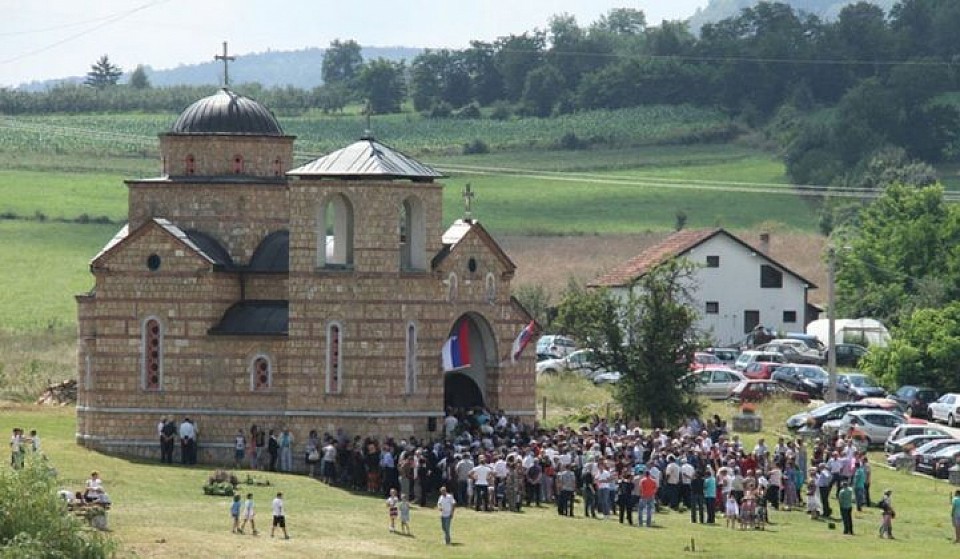
The Church of the Holy Great Martyr Marina in Kriva Reka , a settlement in the municipality of Čajetina , was built between 2006 and 2014 and belongs to the Diocese of Žička of the Serbian Orthodox Church .
The church was built according to the design of the architect Branko Ignjatović from Zlatibor, modeled on traditional sacral architectural solutions. It is a cruciform building with a semicircular altar apse, to which two semicircular conches were added that have the function of a proscomedy and a deaconicon, where both the apse and the conches are vaulted with semi-callotes. The apse is lit by the only bifora in the church. The nave and side spaces are vaulted with semi-circular vaults, which are also visible from the outside, while the central part of the nave is surmounted by an octagonal dome. On the west side is the narthex, of which the bell tower is an integral part on the north side. The narthex is also vaulted with a semi-circular vault. The ground floor and the first floor of the bell tower are connected by stairs, which also lead to the gallery. The bell tower is closed in the lower part, and open in the upper part, with large arched openings, on all four sides. The church is built of brick with mortar joints and inserted rows of bricks, two horizontal and one vertical. All window openings in the church and the narthex-bell tower, as well as the main portal, are arched. On the main, western facade, there are arched mosaics with depictions of Christ and Saint Marina .
Church of Saint Emperor Constantine and Empress Helena in Ljubiš
Church of Saint Emperor Constantine and Empress Helena
in Ljubiš
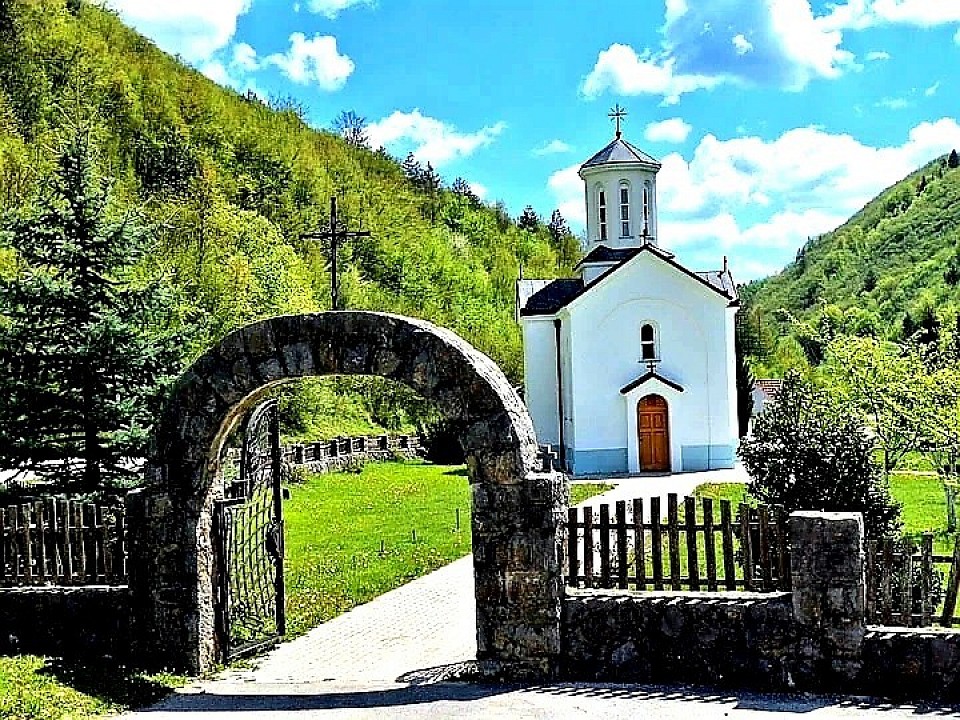
The Church of Saint Emperor Constantine and Empress Helena is located in the village of Ljubiš , municipality of Čajetina , about twenty kilometers from the tourist center. It belongs to the Diocese of Žička of the Serbian Orthodox Church . It was built in 1924 as a parish church for the residents of Gornji and Donji Ljubiš .
History
The idea of building a church originated in 1922, due to the distance of the nearest temples in the neighboring villages of Bela Reka and Sirogojno . A site was chosen for construction in the valley of the Ljubišnica River, between the two largest hamlets in Ljubiš . The initiative was supported by local residents with voluntary contributions, and believers from other regions, including Muslims from Sarajevo, also participated in raising funds.
The project was designed by engineer Miladin Pećinar , a native of this village. Construction work was led by Neđeljko Šuljagić from the village of Draglica , and the wooden carpentry was made by Jefrem Tucović from Gostilje . The temple was completed and consecrated in 1924. That year, the first parish priest, priest Marinko Đurić, was appointed in Ljubiš .
Architecture
The Church of Saint Emperor Constantine and Empress Helena was built in the traditional Serbian-Byzantine style as a single-nave building with a cruciform base, with a semicircular apse on the eastern side and a single dome above the central part of the roof. The brick walls and the gabled roof with a dome form a compact whole. The interior is decorated with a wooden iconostasis with icons painted on canvas.
The church was renovated in 1993. On that occasion, a new copper sheet roof was installed, the bell tower was restored, and the parish house was built. In 2016, work continued on the temple's renovation: a new bell tower was erected and a new interior with modern icons was created.
Parish
The church belongs to the Ljubiško-Belorđečka parish , within the Archdiocese of Užice . The current parish priest is Father Mihailo Đokić.
Address : Ljubiš bb, 31209 Ljubiš
Phone : +381642871584
The log church in Draglica
Church of the Holy Trinity
The log church in Draglica
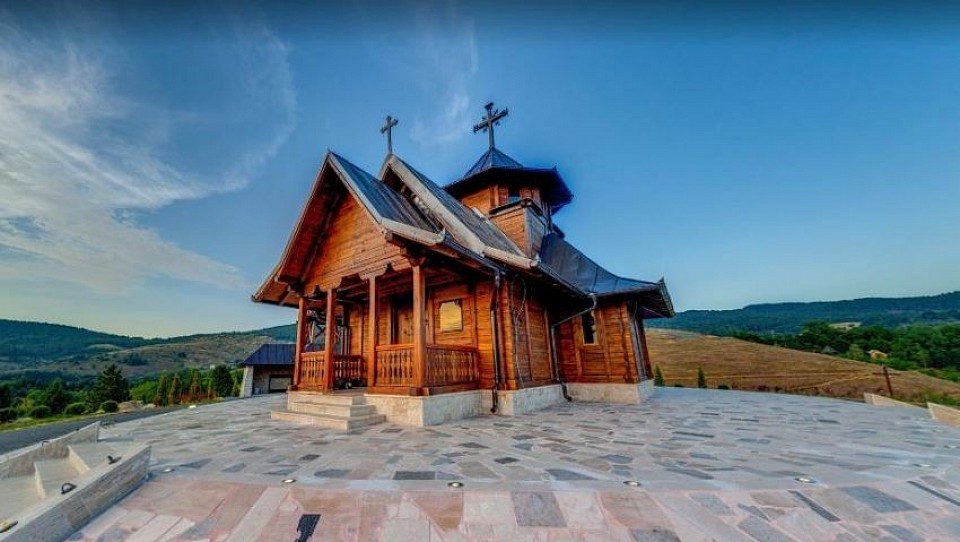
The Log Church in Draglica is a small log church located in the village of Draglica on Zlatibor, in southwestern Serbia. It is dedicated to the Holy Trinity and is under the jurisdiction of the Žica Diocese of the Serbian Orthodox Church .
The construction work on the temple was completed in the first half of 2017. The church was consecrated on June 6, 2017, and the liturgy was led by the Bishop of Žica, Mr. Justin (Stefanović) , with the concelebration of the abbot of the Holy Imperial Lavra of Hilandar, Archimandrite Metodije Marković.
On this occasion, with the blessing of Bishop Justin, Archimandrite Methodius , Abbot Methodius donated a copy of the icon of the Most Holy Theotokos the Milk-Giver .
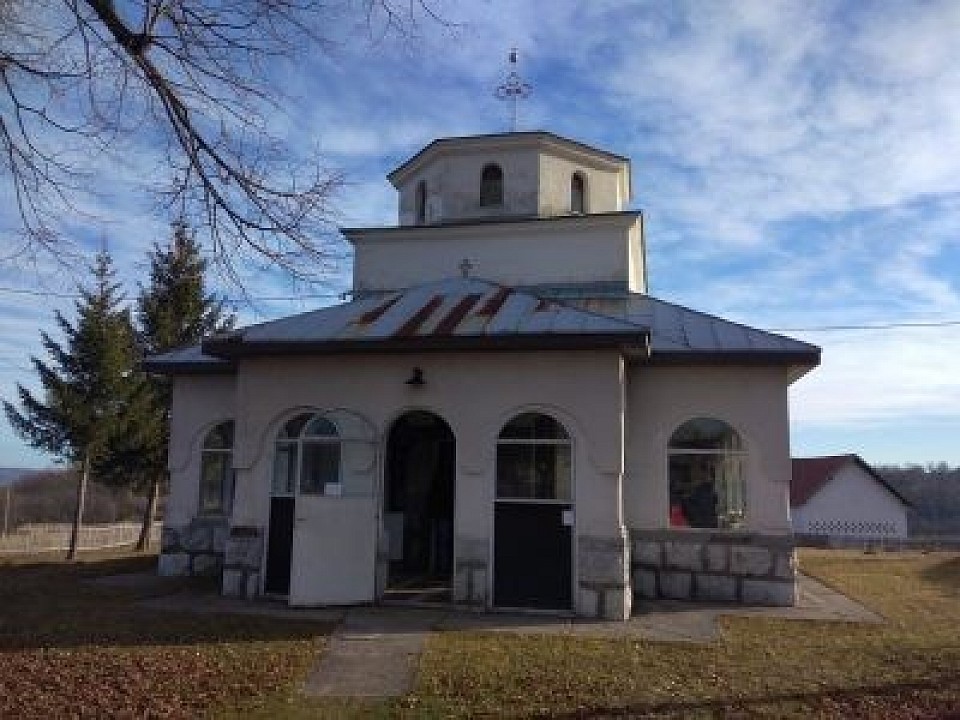
Church of the Nativity of the Blessed Virgin Mary in Šljivovica
Churches in Šljivovica
The Church of the Nativity of the Blessed Virgin Mary is located in the upper part of the Zlatibor village of Šljivovica, in a place called Sjedaljka and belongs to the Diocese of Žička of the Serbian Orthodox Church . The construction of the church began in 1938, at the initiative of the locals and the then parish priest Milutin Milićević. Great contributions were made by the Holy Bishop of Ohrid Nikolaj Velimirović and the Metropolitan of Skopje Josif Cvijović .
The Second World War stopped the work on the church, and construction continued in the 1950s. In 1955, the church received a wooden iconostasis with icons made by the painter Jaroslav Kratina from Belgrade. The icons were a gift from the donors, and their names and the year 1955 are inscribed on each of them. The church was consecrated on September 30, 1956, and the first priest was Dragutin Marković. In 1962, during the ministry of priest Milutin Prodanović, a bell tower was built and a bell was purchased for the church.
The Church of the Nativity of the Blessed Virgin Mary was designed by Momir Korunović , the founder of the Serbian-Byzantine style and one of the most important Serbian architects of the 20th century. It was modeled after the Monastery of the Transfiguration in the Ovčar-Kablar Gorge (according to some sources, this is the only church that was given permission to faithfully copy the appearance of the famous monastery). It is a single-nave building that ends in the east with a semicircular apse, and in the west with a narthex in the form of a rectangular porch with columns. The north and south sides are bordered by porches with massive columns, five on each side, semicircular vaulted, which is reminiscent of the Byzantine influence in architecture. The church is topped by a wide octagonal dome, with regularly spaced windows, on a large cube-shaped base.
In the 1990s, the original roof was replaced, and the narthex was glazed to provide more space for worshippers during the winter months. In 2015, a parish house was built.
In the church gate there are 7 monuments to wayfarers erected in memory of those who died in the village of Šljivovica during the Serbian-Turkish Wars and the First World War .
The current head of the temple is Archpriest Dragiša Đuričić.
Church of Saint Mary Magdalene
In the gentle area of Braneško Polje, at the very entrance to the Zlatibor village of Šljivovica , there is a temple dedicated to Saint Mary Magdalene . Located along the main road, this church represents the spiritual center of this part of the Čajetina municipality and is a symbol of the unity of its residents.
Architecture and appearance The temple was built as a monumental brick building in the Serbian-Byzantine style. It is recognizable by its harmonious central dome and raised bell tower, while the snow-white facade in combination with the stone pediment gives the church a dignified appearance that fits perfectly into the mountain environment. The interior of the temple is filled with light, with a carefully selected wooden iconostasis and marble floor, while the gradually created frescoes further enrich this sacred space.
History and construction The construction of the church began in 2002, and was built exclusively thanks to contributions from locals and local benefactors. After two decades of dedicated work, the temple was fully completed and solemnly consecrated on October 1, 2023. The Great Consecration ceremony was led by Bishop Justin of Žička , and on that occasion, the contribution of the founder Ostoja Stanić and many others who helped make the completion of this place of worship possible was highlighted.
Glory of the temple The church celebratesSaint Mary Magdalene , popularly known as Blessed Mary , which is celebrated on August 4. This holiday is a time when a large number of believers and guests gather in the churchyard, renewing old customs and strengthening the spiritual ties of this Zlatibor region. The head of the church is currently Archpriest Dragiša Đuričić.
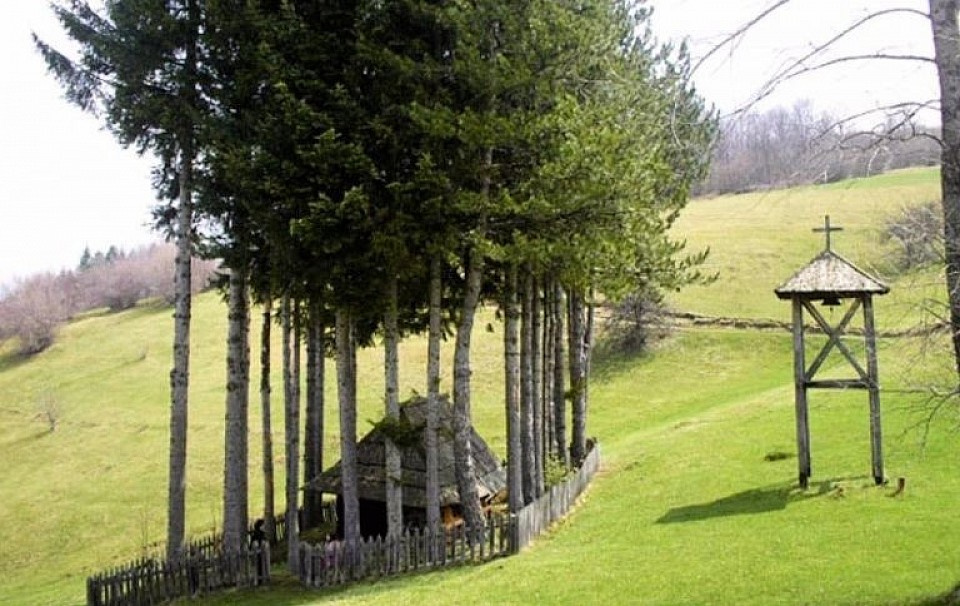
The log cabin church in Peta - Church of the Nativity of the Blessed Virgin Mary in Kućani
The log church in Peta
Church of the Nativity of the Blessed Virgin Mary in Kućani
On the branch of the Murtenica near Kućani , surrounded by a crown of pine trees, vast meadows and pastures, is the smallest, and perhaps the oldest, log church on Zlatibor . The church is a monument of exceptional importance and has been placed under protection.
According to some information, it was built shortly before 1780, while the narthex was added in 1838. The church contains the Imperial Doors, the work of Simeon Lazović , an icon painter from Bijelo Polje . According to the record, the doors were painted in 1780, presumably at the time of the construction of this temple.
The church is built of massive pine logs, with a shingle roof, the deep eaves of which conceal a large part of the walls. Together with the altar area and the narthex, it is 6.5 meters long and 3 meters wide. The height from floor to ceiling is only 2 meters. The western and northern doors are only 112 cm high. The floor is paved with irregularly shaped stone slabs, and the western door in the narthex, which can be assumed to be from the time of the church's construction, is very decorative. Although small, this church was expertly built and is a significant creation of folk builders fromStari Vlach , who during the 19th century and early 20th century were appreciated and known throughout western Serbia, where log houses and log churches were built the most.
The log church in Peta , in Kućani , is not only a cultural and historical treasure, but also a spiritual center and stronghold. Wherever we went, we returned to it. It gathered us for Christmas and Easter, for celebrations and assemblies, always welcomed us into the embrace of reconciliation and forgiveness, was a motive to agree, unite, endure everything - say the highlanders in the heart of Murtenica . Built in the wilderness of the mountains, the miniature church in Peta was, according to legend, transported overnight to a secluded place at a time when the enslaved people's primal urge for self-preservation and faith in God were their only hope. It preserves the imperial doors painted by Simeon Lazović in 1870, and has been covered with shingles on several occasions and has been waiting for a better access from the Jasenovo - Nova Varoš road for years.
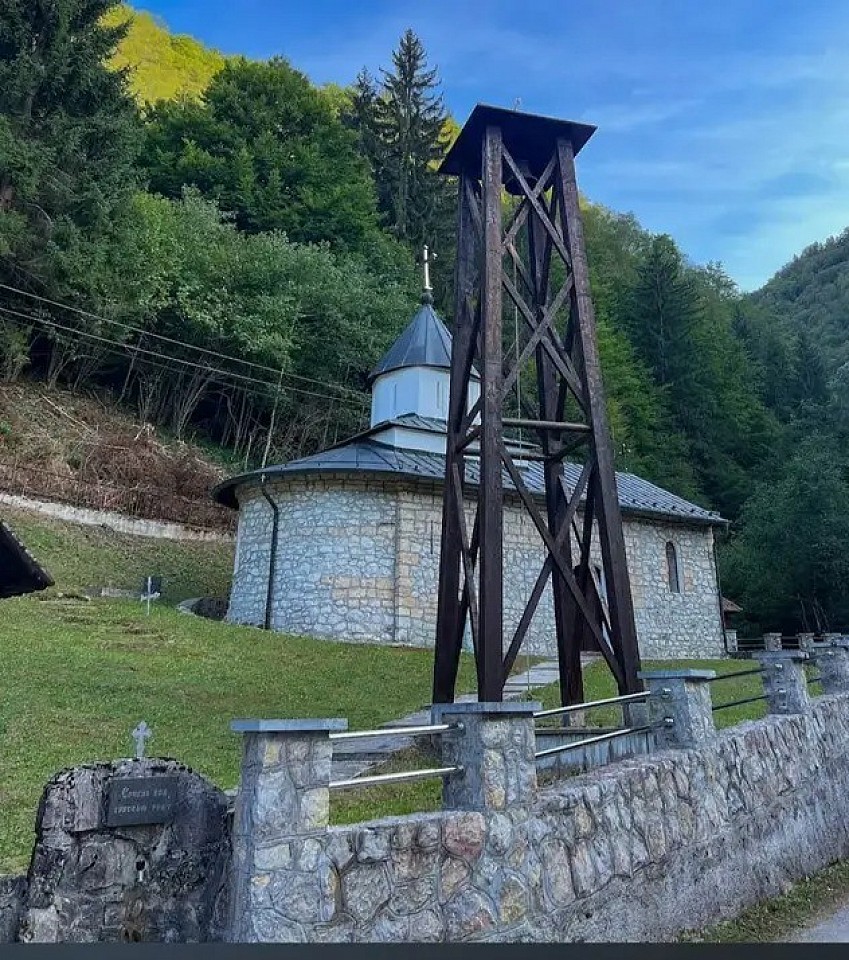
Church of the Transfiguration of the Lord in Bela Reka Zlatibor
Church of the Transfiguration of the Lord
in the White River
On the territory of the municipality of Nova Varoš , at the very entrance to the gorge, there is the Church of the Transfiguration of the Lord . It is located on the right bank of the Belorečka stream, which is known for its caves, so it is believed that in the Middle Ages this area was once inhabited by hermit-hesychast monks.
Sources about its past are not reliable, but based on its architectural characteristics it is assumed that it was built in the first half of the 12th century, although there is also information that mentions even 1810. Also, popular belief connects this church with the Nemanjić dynasty . The church in Bela Reka belongs to the domed type of temples of reduced dimensions. This is a single-nave building built of stone, on the exterior of which there are only small windows without additional decorations. The interior of the temple is characterized by the same simplicity, which is reflected in the barrel-shaped ceiling and the stone-paved floor.
The iconostasis preserves the imperial doors , which were an integral part of the older iconostasis, made in woodcut, with stylized leaf ornamentation and gilding in the post-Baroque manner. The doors are a typical example of the so-called transitional period in Serbian art at the beginning of the 19th century. The icons are without any greater artistic value, except for the Annunciation on the imperial doors, next to which are special icons of the prophet Solomon and the prophet David . It is interesting that in the past there was a door one meter high on the northern side of the church and that anyone who wanted to enter had to lower their head and bend down to enter. Of course, this was used to protect themselves from enemy soldiers who entered the temple on horses. The church was thoroughly renovated in 1810, and during the 20th century, more serious repairs were carried out that significantly changed its former appearance.
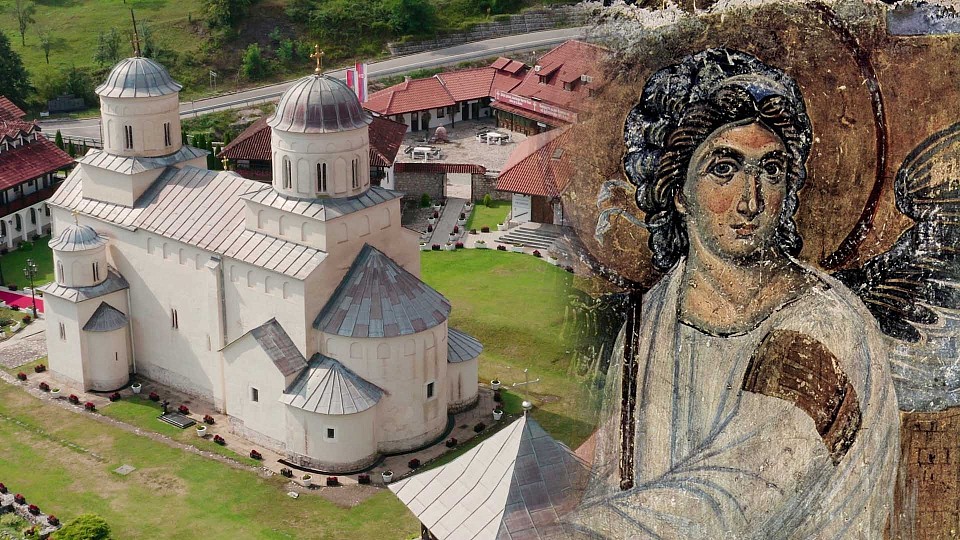
Mileseva Monastery
Mileseva Monastery
The Mileševa Monastery is the seat of the Diocese of Mileševa and one of the most important Serbian monasteries . It was built as the burial church of the župan Vladislav in the early 13th century and is built in the Raška style. It is located right next to Prijepolje , on the banks of the Mileševka River, some 70 kilometers from Zlatibor .
The monastery church is dedicated to the Ascension of Christ . Until 1594 and the burning at Vračar , the relics of the first Serbian Archbishop Saint Sava , whose hermitage was near the monastery, were kept in it. The church was richly painted with frescoes by some of the best European painters of the time. Unfortunately, centuries and Turkish rule have left their mark, and most of the frescoes have been destroyed. Despite everything, the White Angel, one of the most beautiful and significant frescoes of the Orthodox world, has been preserved in Mileševa .
The monastery gate is extremely beautifully decorated and carefully maintained. There are tables and benches in it for resting and staying a little longer in the beautiful monastery complex. If you want to spend the night in this wonderful place, there are monastery lodgings provided for travelers and pilgrims.
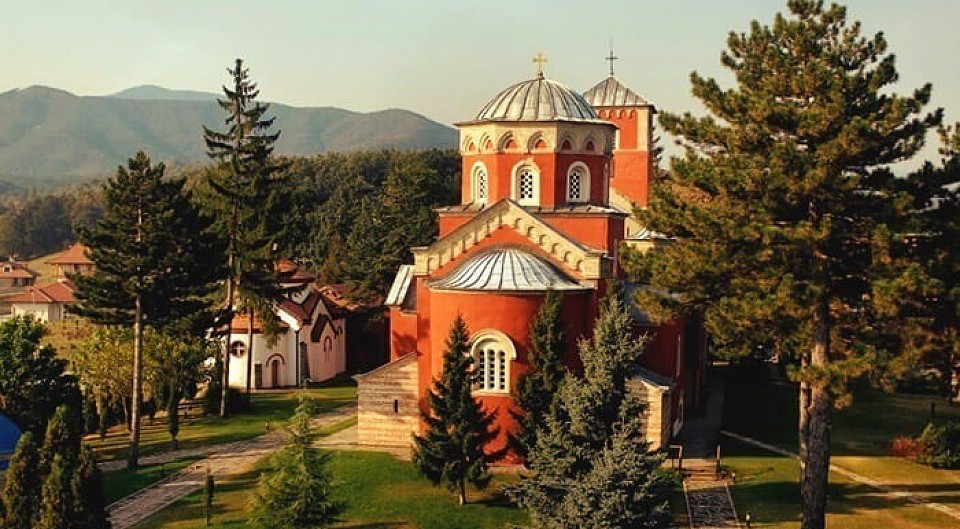
Zica Monastery
Zica Monastery
Žiča Monastery is one of the most important Serbian Orthodox monasteries , located near the town of Kraljevo , in central Serbia. This magnificent monastery was founded in the early 13th century by Saint Sava , the first archbishop of the Serbian Church, together with his brother, King Stefan the First-Crowned . Žiča Monastery was the coronation site of the first Serbian kings and played a key role in the spiritual, cultural and political life of medieval Serbia .
The Žiča Monastery was the center of the Serbian church and state during the early Middle Ages. In 1219, Saint Sava proclaimed the autocephaly of the Serbian Orthodox Church there, making the church independent from the Patriarchate of Constantinople. Many Serbian rulers were crowned in Žiča, including King Stephen the First-Crowned, the first crowned king of Serbia , further cementing the monastery's importance as a center of Serbian statehood and spirituality.
The Žiča Monastery is an example of Serbian medieval architecture, with a distinctive style that combines Byzantine and Romanesque elements. The Church of the Holy Savior , which is the main church of the monastery, is built in the shape of a cross with a large dome above the central part. The facade is characterized by its red color, which symbolizes martyrdom and the sacrifice of Christ.
The interior of the church is richly decorated with frescoes depicting scenes from the lives of Christ, the Virgin Mary, saints, and Serbian rulers. The frescoes of the Žiča Monastery are extremely valuable for their artistic beauty and historical significance, and many of them date from the period when the monastery was at its zenith.
During its long history, it was damaged and restored several times. The greatest destruction occurred during the Ottoman conquests, when the monastery was burned and devastated. In the 19th and 20th centuries, the monastery was rebuilt, and a major restoration was carried out after World War II.
Today, the Žiča Monastery is an active nunnery and an important spiritual center, attracting numerous believers and visitors from all over the world. As a cultural asset, the monastery is of exceptional importance for the Republic of Serbia and is included in the UNESCO World Heritage List.
